

How to test the quality of wire rope?
Apr 01, 2026
Leave a message
Hey there! As a wire rope supplier, I've seen firsthand how crucial it is to ensure the quality of wire ropes. Whether it's for industrial use, construction, or even decorative purposes, a high - quality wire rope can make all the difference. In this blog, I'm gonna share some tips on how to test the quality of wire rope.
Visual Inspection
The first and easiest way to start testing a wire rope is through a visual inspection. You don't need any fancy equipment for this one. Just take a good look at the rope.
Check for any signs of corrosion. Corrosion can weaken the wire rope over time, and it's often visible as rust or discoloration on the surface. If you see patches of rust, especially in a large area, that's a red flag. For example, in a Stainless Steel 316 Wire Rope, which is known for its corrosion - resistance, any sign of rust could indicate a problem with the manufacturing process or improper storage.
Look for broken wires. Even a single broken wire can be a sign of excessive wear or stress. Run your hand gently along the rope (be careful not to cut yourself), and you might feel a rough spot where a wire has snapped. Broken wires can reduce the strength of the rope significantly, and if you find multiple broken wires close together, it's time to consider replacing the rope.
Inspect the rope for kinks or twists. Kinks can cause uneven stress distribution in the rope, which can lead to premature failure. A kinked wire rope might not be able to handle the load it's designed for, and it could break under normal operating conditions. This is especially important for Cable Wire Rope Railing Balustrade, where safety is a top priority.
Dimensional Checks
Another important aspect of testing wire rope quality is to perform dimensional checks. You'll need a caliper or a micrometer for this.
Measure the diameter of the wire rope at several points along its length. The diameter should be within the specified tolerance for the type of rope. If the diameter is too small, the rope might not have the required strength. On the other hand, if it's too large, it might not fit properly in the equipment it's intended for.
Check the pitch of the rope. The pitch is the distance between two adjacent strands. A consistent pitch is a sign of a well - made rope. If the pitch varies significantly, it could mean that the rope was not manufactured correctly, which can affect its performance.
Tensile Testing
Tensile testing is a more advanced way to test the quality of a wire rope. This test measures the maximum amount of tension the rope can withstand before breaking.
You'll need a tensile testing machine for this. First, you'll cut a sample of the wire rope to a specific length. Then, you'll attach the sample to the testing machine. The machine will gradually apply tension to the rope until it breaks.
During the test, you'll record the maximum load the rope can handle. Compare this value with the manufacturer's specifications. If the actual breaking strength is significantly lower than the specified strength, it means the rope might not be of good quality. Tensile testing is especially important for Galvanized Wire Rope for Lifts, where the safety of passengers depends on the strength of the rope.
Fatigue Testing
Wire ropes are often subjected to repeated loading and unloading cycles in real - world applications. Fatigue testing simulates these conditions to see how well the rope can withstand long - term use.
In a fatigue test, a sample of the wire rope is loaded and unloaded a certain number of times at a specific load level. The test continues until the rope fails or reaches a predefined number of cycles.
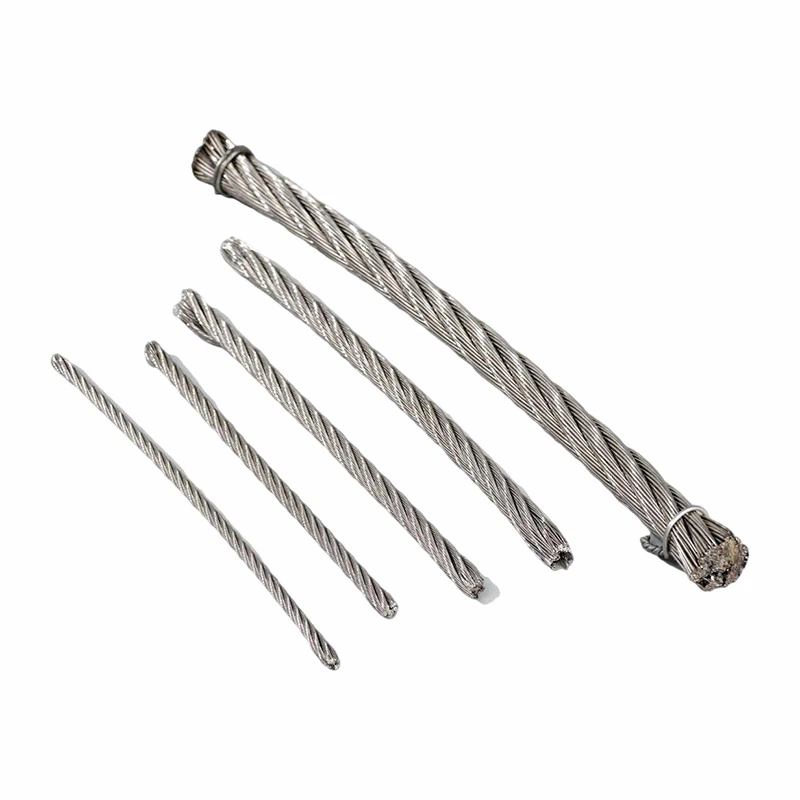

The results of fatigue testing can tell you a lot about the durability of the wire rope. A rope that can withstand a large number of cycles without failing is a high - quality rope. This type of testing is crucial for applications where the rope is used frequently, such as in cranes or elevators.
Chemical Analysis
Chemical analysis can be used to determine the composition of the wire rope. This is important because the chemical composition affects the properties of the rope, such as its strength, corrosion resistance, and ductility.
There are several methods for chemical analysis, such as spectroscopy or wet chemical analysis. These methods can identify the elements present in the wire rope and their percentages.
For example, in a stainless steel wire rope, the percentage of chromium and nickel is important for its corrosion resistance. If the chemical analysis shows that the percentages are outside the normal range, it could explain why the rope is corroding or not performing as expected.
Magnetic Particle Testing
Magnetic particle testing is a non - destructive testing method used to detect surface and near - surface defects in ferromagnetic wire ropes.
In this test, a magnetic field is applied to the wire rope. If there are any defects, such as cracks or broken wires, the magnetic field will be distorted. Then, magnetic particles are applied to the surface of the rope. The particles will accumulate at the sites of the defects, making them visible.
Magnetic particle testing is a quick and effective way to detect hidden defects in wire ropes. It's especially useful for ropes that are in service and need to be inspected regularly without causing damage.
Ultrasonic Testing
Ultrasonic testing is another non - destructive testing method. It uses high - frequency sound waves to detect internal defects in the wire rope.
An ultrasonic transducer is placed on the surface of the rope, and it sends out sound waves. These waves travel through the rope, and if there are any internal defects, such as voids or inclusions, the sound waves will be reflected back. The transducer then detects these reflections and converts them into an electrical signal, which can be analyzed to determine the location and size of the defects.
Ultrasonic testing is a very sensitive method and can detect defects that are not visible to the naked eye. It's a great way to ensure the integrity of the wire rope, especially for critical applications.
Conclusion
Testing the quality of wire rope is a multi - step process that involves visual inspection, dimensional checks, and various testing methods such as tensile testing, fatigue testing, chemical analysis, magnetic particle testing, and ultrasonic testing. By using these methods, you can ensure that the wire rope you're using or supplying meets the required standards and is safe for its intended application.
If you're in the market for high - quality wire ropes or need more information about wire rope testing, don't hesitate to reach out. We're here to help you make the right choice for your needs. Whether it's a Stainless Steel 316 Wire Rope, Cable Wire Rope Railing Balustrade, or Galvanized Wire Rope for Lifts, we've got you covered. Let's start a conversation about your wire rope requirements today!
References
- ASTM International standards for wire ropes
- Machinery's Handbook for information on wire rope testing methods
- Manufacturer's specifications and guidelines for wire ropes
Send Inquiry